Taming the sun with PV flexibility in Switzerland


Powernaut & Romande Énergie
Facts and Figures
Type: Energy retailer
Location: Switzerland
Sites: Full injection and self-consumption sites
Assets Managed: Solar installations
Business Target: MVP by January 2026
Forecast Accuracy: ~12 kWh average error per quarter-hour for 1.35 MWp pool
Key Result: Validated technical and business case for distributed PV portfolio self-balancing
Context
Switzerland's energy scene is very active, with utilities racing to integrate growing renewables like solar without upsetting the grid or their portfolios. All this is happening at the time when legislation is catching up and market liberalisation and energy communities are a hot topic.
Problem
As more customers installed solar panels, Romande noticed rising balancing costs. They saw this growth not as a problem, but as an opportunity to apply the extra flexibility from these small, spread out solar installations for balancing their portfolio.
Solution
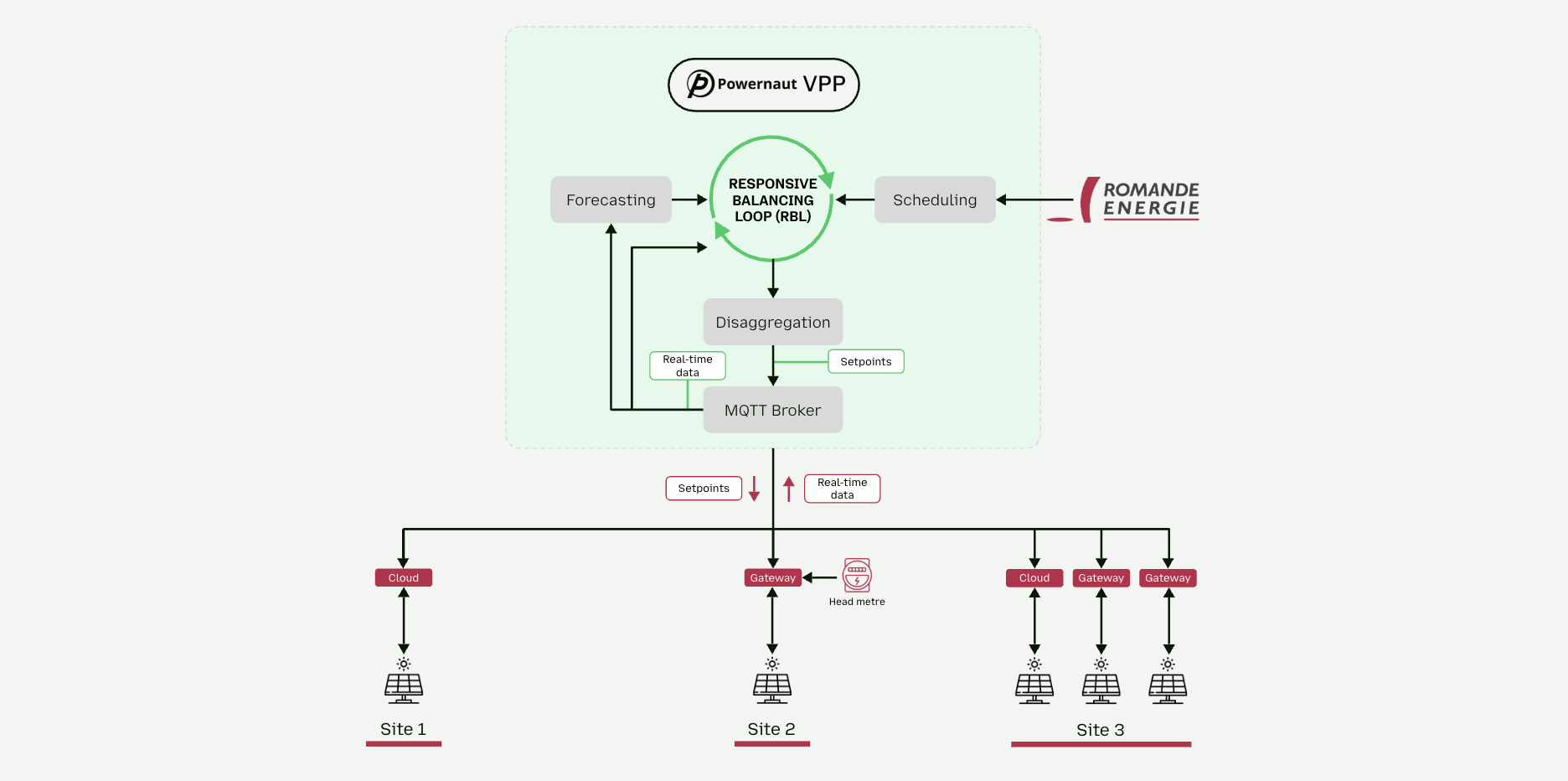
Powernaut's flexibility workspace provided the perfect Open Virtual Power Plant (VPP) platform to aggregate and steer solar installations, integrate with forecasting tools, connect with 3rd party APIs and perform accurate baseline calculations for billing all geared toward portfolio self-balancing.
Approach
The collaboration was agile, beginning with a Proof of Concepts on three PV sites following an RFP win tested alongside longtime incumbents in the flexibility space. This scaled to a Minimum Viable Product (MVP) with deep integration into Romande's trading and billing systems
Impact
Romande now has in place a scalable, future-proof platform for managing distributed PV assets which is expandable to batteries, EVS and heat pumps. The project validated the business case, out performed competitors on reliability and positioned Romande as a leader in decentralised flexibility in Switzerland
From solar growth to imbalance costs
As more customers installed solar panels, Romande saw imbalance costs rise. Managing a growing number of small, decentralised PV assets made real-time control increasingly complex.
The key challenge was clear: how to precisely monitor, pool, and steer distributed solar installations without compromising customer self-consumption or operational reliability.
“The problem we had was connecting and steering many decentralised assets, especially solar. ”
Patrick Biro, Venture Architect at Romande Énergie
Powernaut’s flexibility workspace provided an Open Virtual Power Plant designed for exactly this scenario. It allowed Romande to aggregate distributed PV installations and operate them as a single, controllable portfolio.
At the heart of the solution:
- Real-time portfolio self-balancing
- Smart disaggregation down to site level
- Accurate day-ahead and intraday forecasting
- Seamless integration with trading and billing systems
“Powernaut allowed us to steer all these assets as if they were one power plant”
Patrick Biro, Venture Architect at Romande Énergie
How we worked: Prove it, then scale it
In short, Powernaut gave Romande exactly what it needed: one workspace to aggregate and steer a distributed PV portfolio and balance it in near real time. Here’s how we got there:
The collaboration followed a pragmatic, step-by-step approach focused on proving value early.
- Proof of concept
After winning a competitive RFP, Powernaut and Romande launched a PoC across three PV sites, covering both full-injection and self-consumption setups. - Real-world testing
Manual activations, forecast accuracy, and steering stability were tested under live conditions, alongside incumbent flexibility providers. - From PoC to MVP
The success of the pilot paved the way for a full MVP, deeply integrated into Romande’s trading and billing operations.
“Powernaut allowed us to steer all these assets as if they were one power plant”
Patrick Biro, Venture Architect at Romande Énergie
Flexibility that reaches consumers
The results validated both the technical and commercial case for distributed PV flexibility.
“If energy and flexibility aren’t integrated, it’s the consumer who gets less value and higher costs”
Patrick Biro, Venture Architect at Romande Énergie
High-precision portfolio control
Average deviations of just ~12 kWh per quarter-hour across a 1.35 MWp solar pool.
Lower imbalance risk and costs
By actively steering distributed PV in near real time, Romande significantly reduced exposure to imbalance penalties and improved portfolio self-balancing.
A platform built to grow
What started with solar is ready to expand to batteries, EVs, and heat pumps, providing a future-proof flexibility backbone as asset diversity increases.
Value reaching end consumers
Better portfolio control and integrated flexibility enable more competitive pricing and ensure customers benefit directly from the energy transition.
Working as one team
From day one, the collaboration was hands-on and iterative. By testing ideas early, aligning closely with trading and operations teams, and focusing on real-world constraints, Powernaut and Romande Énergie were able to move quickly from pilot to production.
Beyond solar
With a scalable flexibility platform in place, Romande is positioned to grow both the volume and variety of assets under management.
What started with solar is becoming the foundation for a broader decentralised flexibility strategy — one that supports the grid, the portfolio, and the people connected to it.
Find out what Powernaut can do for your energy business.
Get to know us
Discover our demo
Onboard your first asset