
TL;DR
- Home solar, batteries, heat pumps and EVs can balance the grid without new industrial batteries.
- Economic and environmental motives drive participation, with acceptance of 40% to 70%.
- Mass adoption needs better technology, education and market incentives.
Our reliance on renewables has reached an all-time high, but matching demand to their irregular supply is hard, and it leaves our grids with a stability problem. Today the industry leans heavily on building new industrial batteries. They work, but they need huge investment and their manufacture depletes the planet's resources.
What if we use the assets already installed?
Adoption of home solar, batteries, heat pumps and EVs is skyrocketing. These distributed assets can balance the grid and cut CO₂. That is residential flexibility, in two parts: demand response, shifting or reducing use away from peaks, and using the assets to supply the grid when needed. If all residential and industrial buildings take part, smartEN reports we could save 37.5 million tonnes of CO₂ in 2030.
Are people willing to take part?
A Finnish study looked at consumers' willingness to enrol home appliances, heat pumps and EVs in demand response.
- The main motivators are economic or environmental.
- Appliances and heating have at least 40% acceptance, rising to 70% among economically motivated people.
- Expected compensation averages €100 a year for EVs and appliances, and up to €200 a year for heating.
Who is interested, and who isn't?
- Older consumers are less receptive, so willingness falls with age.
- People with a higher education are more supportive.
- Households without children are more willing to enrol heating and EVs.
- Moderate incomes, around €3,500 to €4,500 gross a month, showed the highest willingness to enrol appliances.
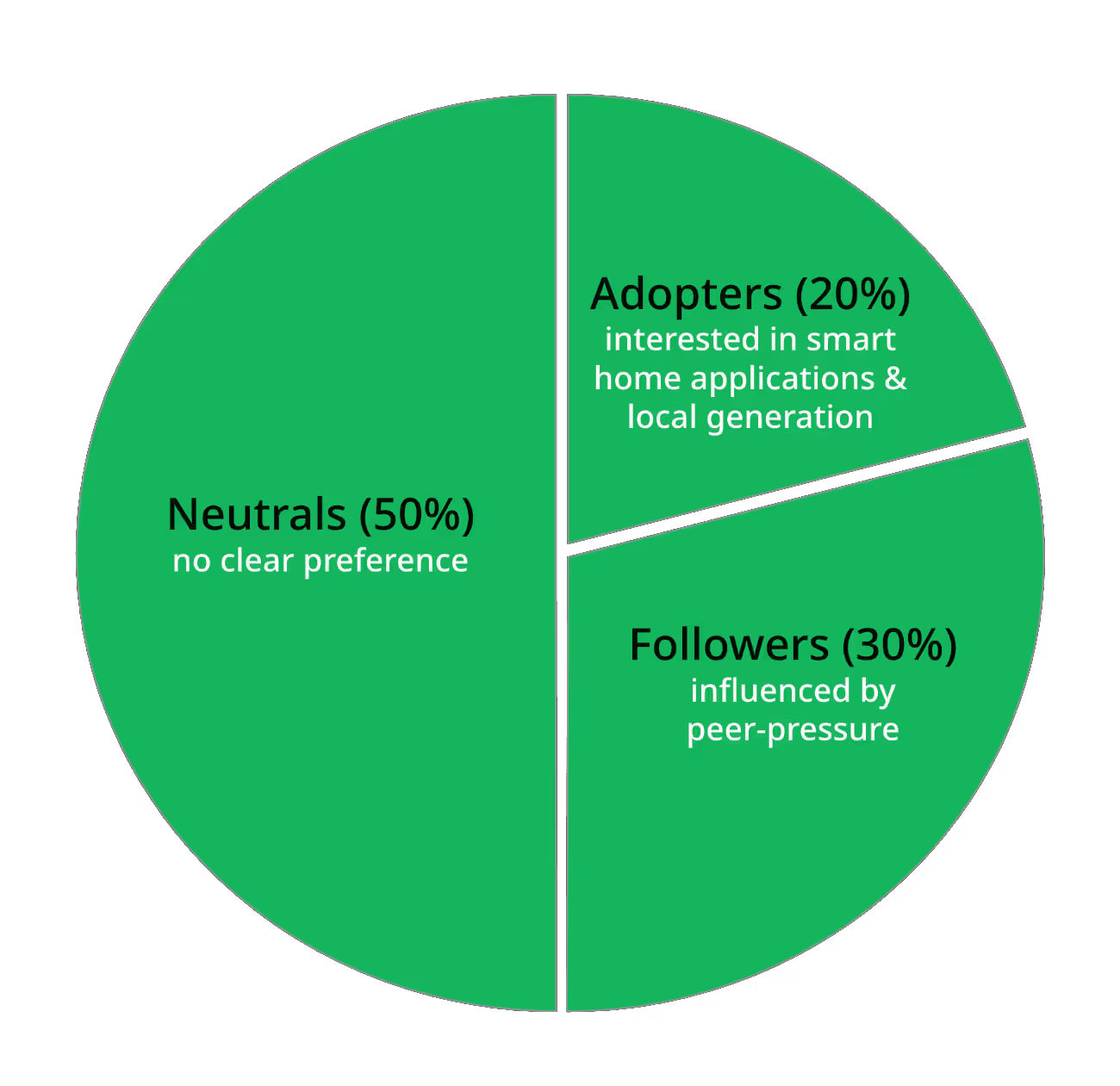
The ideal early group is young, educated, childless households on moderate incomes. Clustering the data shows three groups: adopters who already optimise with smart devices, followers who join once enough others do, and neutrals who are undecided, probably uninformed, and need a big incentive.
A couple of things to keep in mind
The survey went to 30,000 customers of PKS in Finland, and 1,468 answered, so respondents may already be interested. Finland also has above-average climate awareness and a renewable mix of 48%, second in the EU. And it ran before the energy price spike after Russia invaded Ukraine, which has since raised awareness of renewables and flexibility under REPowerEU.
What mass adoption needs
- Technology: reliable, scalable software managing many kinds of home assets, without restricting consumers and with strong privacy.
- Education: people need to understand the need and the economic opportunity, so trust grows.
- Market incentives: programs must make the CO₂ savings and the financial reward clear.
In Belgium, the Flemish government's Flexibility Plan 2025 tackles education and incentives with Fluvius, including an information campaign and easier access to smart controllers, heat pumps, chargers and batteries. On the technology side, better AI prediction models and cloud connectivity are opening up new possibilities.