TL;DR
- Market liberalisation: many Swiss consumers cannot choose their supplier today. That potentially changes from 2026 onward.
- Public support: in 2023, 68.7% of Swiss voters approved the Renewable Energy Act.
- The opportunity: with liberalisation in 2026 to 2027 and legal backing for energy communities, retailers who understand flexibility can help build the distributed energy system from the ground up.
Grüezi, energy innovators. Switzerland isn't just famous for chocolate and precision watches anymore. The country is quietly engineering one of Europe's most ambitious energy transformations, and it is opening up real opportunities for retailers who understand flexibility.
Why the timing couldn't be better
Switzerland is facing what we call the Alpine energy trilemma:
- A nuclear phase-out by the 2040s, leaving capacity gaps
- Winter hydropower limits when the Alpine reservoirs run low
- Growing solar adoption, creating daily supply and demand mismatches
Energy communities are the game-changer
Switzerland's new energy community legislation allows peer-to-peer trading and forces a rethink of how energy flows through the system.
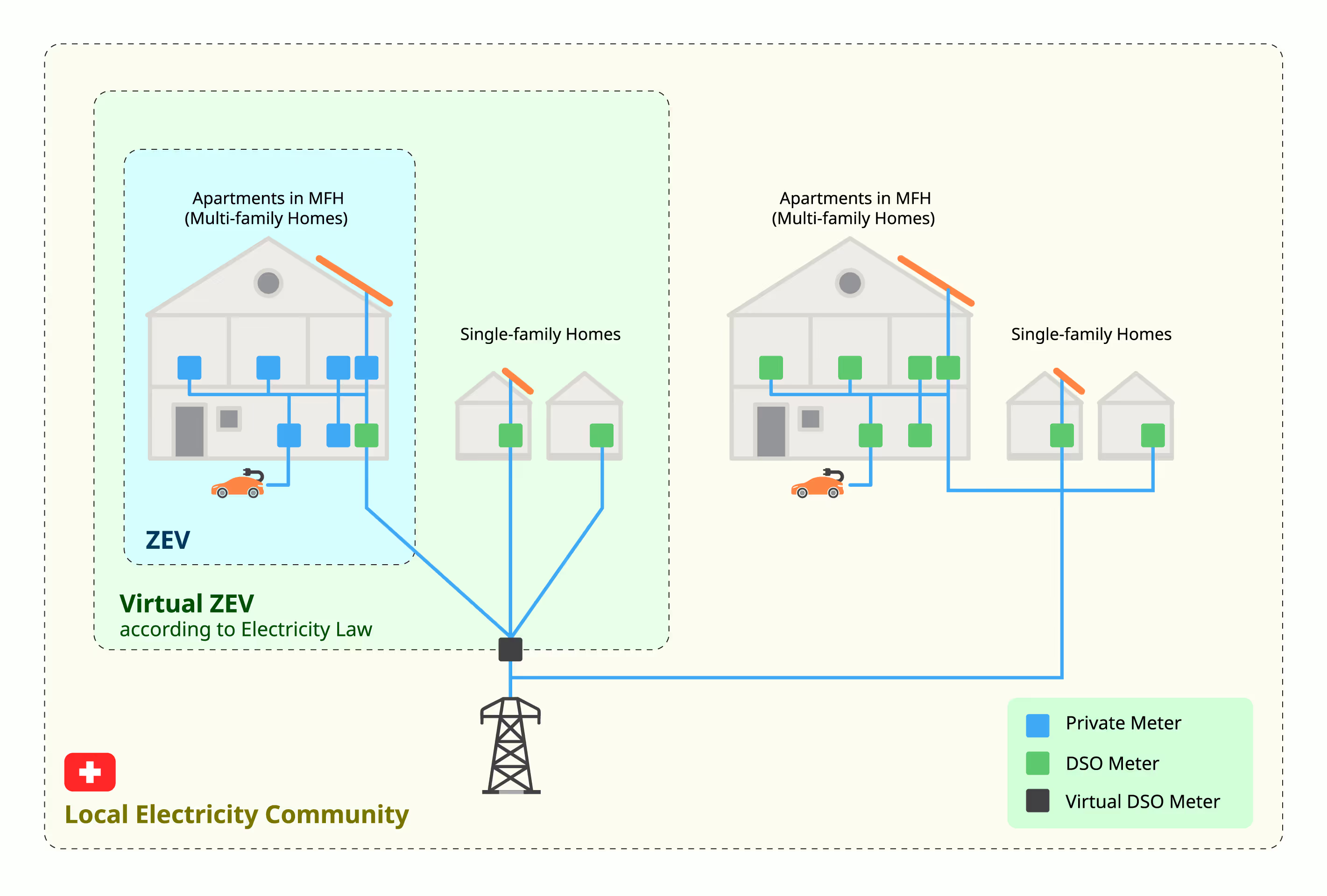
Local energy communities
Imagine a solar-rich business park in Zurich where one company generates 200% of its needs while its neighbour barely produces 10%. Under the old system, the excess went to the grid for around 6 cents per kWh. Now they can trade directly at 15 cents per kWh with a 40% discount on transmission costs.
Consumer associations
Apartment buildings, housing cooperatives and business districts are forming buying groups with real purchasing power. They want green energy, competitive prices, dynamic tariffs, demand response and storage optimisation. They are looking for partners who can handle complexity, not commodity suppliers.
The flexibility value stack is about to grow
- Arbitrage: as dynamic pricing becomes the norm, peak and off-peak spreads create consistent opportunities for retailers with storage to buy low, sell high and share the profits.
- Grid services: as Switzerland integrates further with EU markets through its 41 cross-border connections, retailers who aggregate flexible assets can earn on frequency and voltage support.
- Community optimisation: energy communities need sophisticated management, so the supply contract becomes an energy management partnership.
- Demand response at scale: with 583 MW of new backup capacity planned by 2026, avoiding expensive peaker plants is worth a lot.
The early mover advantage is real
The biggest opportunities go to those who show up early with the right solutions, and Swiss pilots are already proving it:
- Quartierstrom in Walenstadt reached 33% local self-sufficiency, double the baseline.
- Zurich housing complexes are hitting 90% solar self consumption with smart coordination.
- Geneva cooperatives show that prosumer communities can thrive with the right support.
- Powernaut's roll-outs with energy retailers, including Swiss players, are proving flexibility value for retail customers.
What this means for your business
Groupe E's Vario tariff shows dynamic pricing already works in practice.
Portfolio balancing: solar first, battery second
Liberalisation will require fast adjustments to offtake and injection to avoid imbalance penalties, which can spike to 100 to 200 CHF/MWh during high solar variability. Solar is the starting point, with imbalance reduction value of up to 50 CHF/kW a year, based on Swissgrid interventions where solar booms caused 1.4 GW imbalances.
Adding a battery amplifies that. A typical 8 to 10 kWh system costs CHF 10,000 to 21,000 and saves CHF 1,500 to 2,000 a year, with a payback of 8 to 14 years. Retailer compensation programs can shorten that. Heat pumps are too slow for rapid response, and EVs are limited until V2G is mainstream.
Fixed tariffs with flexibility incentives
EV adoption is strong, at 28% of new registrations in 2024. A back-of-the-napkin scenario: smart EV steering could save CHF 280 per vehicle a year. If you keep 20% of that, about CHF 56, that is CHF 560,000 in extra revenue for 10,000 customers, plus better retention.
The time to act is now
The legal framework is in place, pilots are proving the concepts, and consumers are ready. Switzerland is about to become Europe's flexibility laboratory, and the retailers who show up with the right solutions will write the playbook for the rest of the continent.